Student intern: Tianchen Wu (Computer Science)
Supervisors: Mark James (School of Biology), Angela Miguel (School of Computer Science)
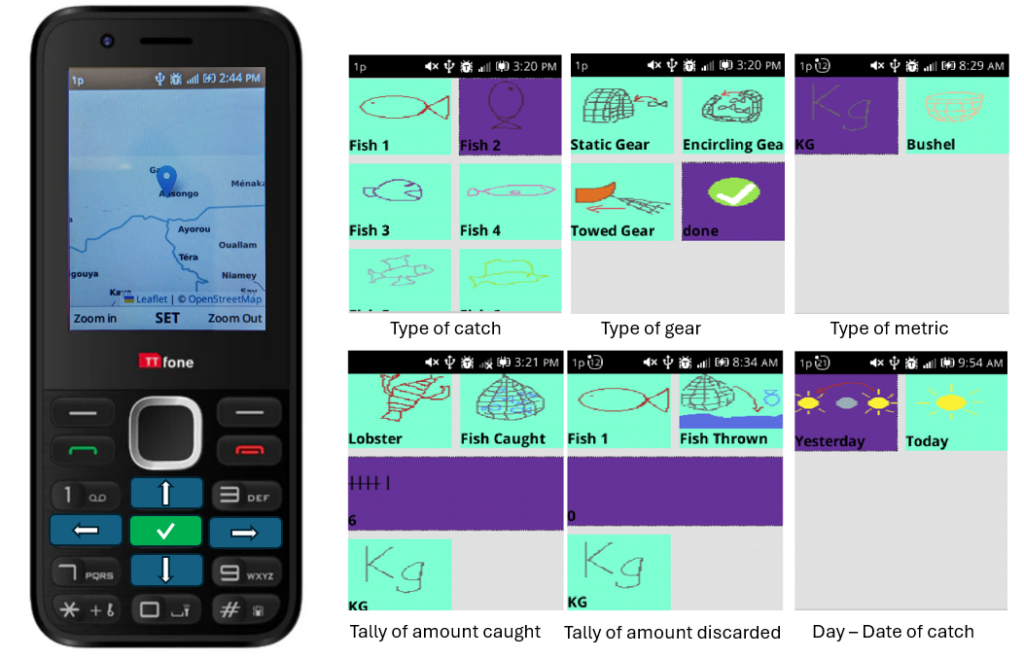
There are about 14 million small scale fishing (SSF) vessels representing about 80% of the global fishing fleet. For most SSF there is little information about how and where they fish, what they catch and how much. Many of these fisheries are illegal, unreported and unregulated (IUU). The Coastal Resources Management Group at the Scottish Oceans Institute at the University of St Andrews has been developing technology, processes and systems to collect data on SSF, including the use of mobile Apps. Literacy rates can be low amongst fishers in some countries. This BIRCH project was designed to explore the potential to develop an App that would allow marginalised groups such as those with limited or no literacy skills to be able to use Apps to provide information about their catch, bycatch and location of fishing activities. Feature phones are still used widely in some countries because they are relatively cheap to buy and have long battery life. The challenge for this project was to explore the potential to create a simple icon based App which could function effectively on a basic £30 feature phone. A set of simple pictograms and universally recognisable icons were developed to allow users to intuitively navigated the App using either the navigation button on the phone or the larger buttons on the keypad with 2 = up, 8=down, 4= left, 6=right and 5=enter or ok. In a working version, key symbols could be converted from numerals to arrows. Using the phones GPS fishers could record their fishing vessel tracks and select a position on a map to confirm the position of the fishing location. Icons to allow the fisher to select the:
- type of fishing gear used
- main type of catch, based on images of fish for example
- metric they use to identify the amount of catch which could be number of individual fish caught, weight or some other unit measure such as bucket or basket
- a simple tally symbol equating to the amount caught – linked to the metric or unit of catch.
The catch and GPS data is stored on the phone. Ultimately, the App should allow fishers to submit their data directly to a database via the mobile phone network. Fishers would be able to see their own catch information displayed in ways that would be meaningful and see how it changes over time. Fisheries managers would have access to data needed to inform the sustainable management of the fishery.